
Strand E: Earth and Space Systems
In this lesson, you will learn about rocks and how they change over time. This is called the rock cycle.
You will learn about three types of rocks. Igneous rocks form when hot melted rock cools and hardens. Sedimentary rocks form when small pieces of sand, mud, and rock press together in layers. Metamorphic rocks form when rocks change because of heat and pressure deep underground.
You will also learn that rocks can change from one type to another. By the end, you will be able to explain how rocks form and change in the rock cycle.
Students are expected to explain the geological processes that result in the formation of igneous, sedimentary, and metamorphic rocks, and describe how these changes occur through the rock cycle (Overall Expectation E2.1).
🐝 Welcome to KidsHive Learning!
Step 1: Read the Book
Open the book and explore new ideas before moving to the quiz.
Step 2: Take the Quiz
Answer the questions and test what you learned.
Step 3: Earn Your Achievement
Complete the quiz and become a KidsHive Learning Star!
Read Me

🌟 The Rock Cycle 🌟
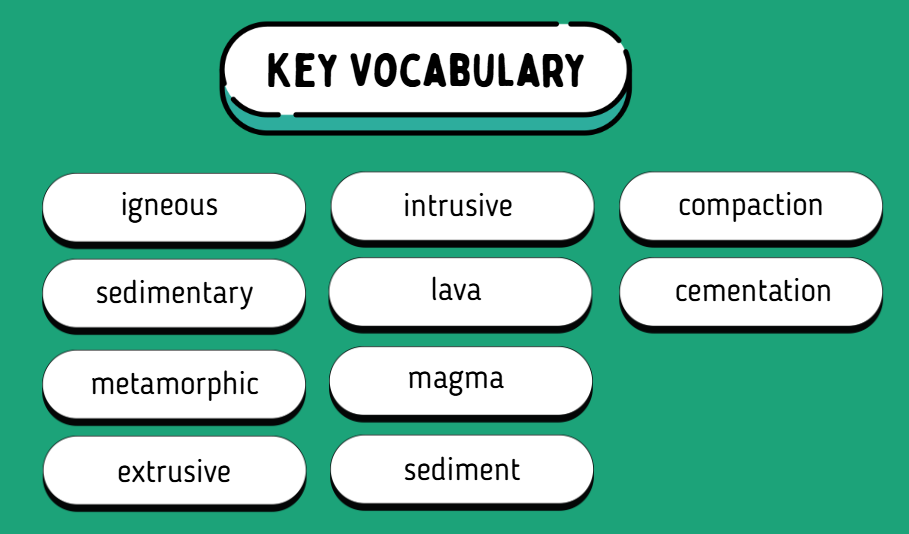
Learning your science words will help you understand the lesson better.
Practice these key words often. This will help you remember them and feel more confident when talking about rocks and the rock cycle!
Worksheets for practice
Engaging Science Video
Watch this amazing Video from Science Trek about Rocks. Science Trek is a local public television program presented by IdahoPTV.
Find out how rocks brought to Earth by the Apollo astronauts have helped NASA learn more about the rock cycle. Compare igneous, sedimentary and metamorphic rocks found on Earth to three types of rocks found on the moon.